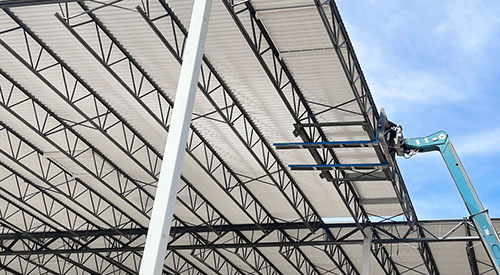

In today's warehouse and distribution center market, daylight is no longer just a design preference, it's a code requirement. For structural engineers working in California, Oregon, Washington, and increasingly across North America, energy regulations now mandate that a specific percentage of roof area be dedicated to daylighting.
While these requirements support sustainability goals, they have also created a persistent tension between energy compliance and construction budgets. For years, meeting daylighting targets with steel roof decking required additional framing and costs, often pushing projects toward alternative structural solutions.
Today, that equation is changing.
By aligning structural layouts with standardized skylight dimensions, engineers can now achieve compliant daylighting without added framing, added labor, or added cost. This "no-curb" "no-frame" ??? approach is helping steel compete head-to-head with hybrid systems, while delivering the durability, fire resistance, and long-term performance the market demands.
For decades, conventional steel deck products were not designed with skylight integration in mind.
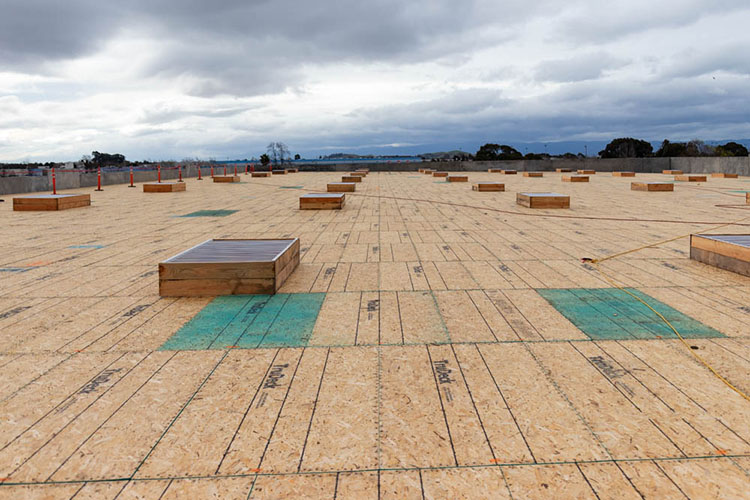
Standard B-Deck is manufactured in 3 ft wide sheets. Meanwhile, the West Coast roofs have long coalesced around 4 ft wide modules across the entire footprint. Plywood sheets - and most skylights - are produced in 4 ft x 8 ft sizes. Leaving out a single panel created a skylight opening with no additional framing.
This dimensional mismatch meant skylights rarely aligned cleanly with steel deck flutes or joist layouts. Instead, openings often landed between structural elements, forcing engineers to design extensive supplemental framing below the deck. That adds material, labor, and coordination complexity. Eliminating these frames can provide savings up to $1 / square foot while meeting 2% daylighting requirements for a large roof.

That inherent efficiency helped wood hybrid roofs maintain a long-standing cost advantage. But this limitation of steel was never structural in nature. It was geometric. And once the industry recognized that, a better solution became possible.
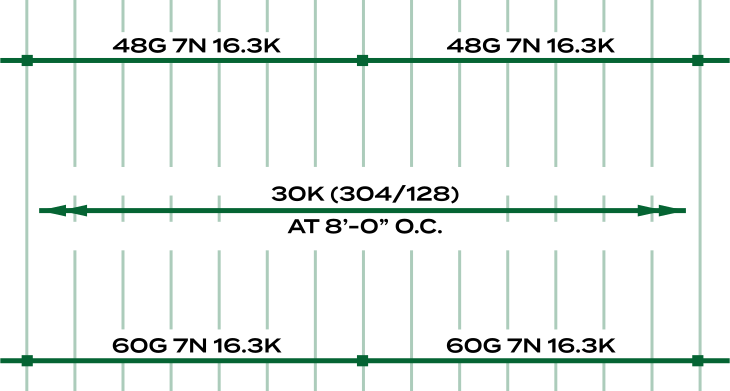
The breakthrough came from rethinking the structural grid itself.
Rather than forcing skylights to adapt to traditional steel layouts, our engineers asked a different question: What if the deck and joist spacing were designed around skylights from the start?
The answer was the 4 ft module. Joists stay at their current typical 8 ft spacing. Instead of using plywood sheathing, Verco's 48" wide N-Deck (abbreviated "N-48") is specified. It aligns perfectly with standard 4' x 8' skylights, resulting in immediate cost savings and a cleaner structural solution.
Traditionally, 1.5 inch deep B-Deck was used for 5 ft to 6 ft spans. Extending that span to 8 ft typically required 20ga or 18ga depending on diaphragm requirements, driving up material costs.
Verco addressed this challenge by adopting Grade 80 Class 3 steel. As defined in ASTM A653, this steel offers high strength with intermediate ductility, allowing more elongation, higher tensile strength and ultimately stronger connections.
The resulting 1.5N-48 profile delivers:
All while remaining in 22-gauge thickness.
The result is a system that is approximately 15% lighter than conventional B-Deck for the same gauge, yet capable of spanning eight feet while meeting diaphragm and vertical load requirements.
The shift from 3 ft to 4 ft deck may appear incremental, but it represents a fundamental correction in how steel roofs are designed for modern warehouses.
By aligning structural grids with skylight geometry, Verco's N-48 system eliminates unnecessary framing, reduces installed costs, and simplifies coordination across trades. It transforms daylighting from a budget liability into a built-in advantage.
For structural engineers designing distribution centers and logistics facilities, moving beyond a "B-Deck at six feet" default can unlock substantial project-wide savings.
The future of efficient, compliant warehouse design is not about adding complexity. It's about better alignment… of materials, geometry, and market needs. And that alignment is now built into the deck itself.
About the author
Pat Bodwell is a Senior Innovator for the Vulcraft/Verco Innovation Services Group. Lorem ipsum dolor sit amet, consectetur adipiscing elit, sed do eiusmod tempor incididunt ut labore et dolore magna aliqua. Ut enim ad minim veniam, quis nostrud exercitation ullamco laboris nisi ut aliquip ex ea commodo consequat. Duis aute irure dolor in reprehenderit in voluptate velit esse cillum dolore eu fugiat nulla pariatur.